No.013 · 🇰🇷 Korea · Monsters & cryptids
Bulgasari
불가사리
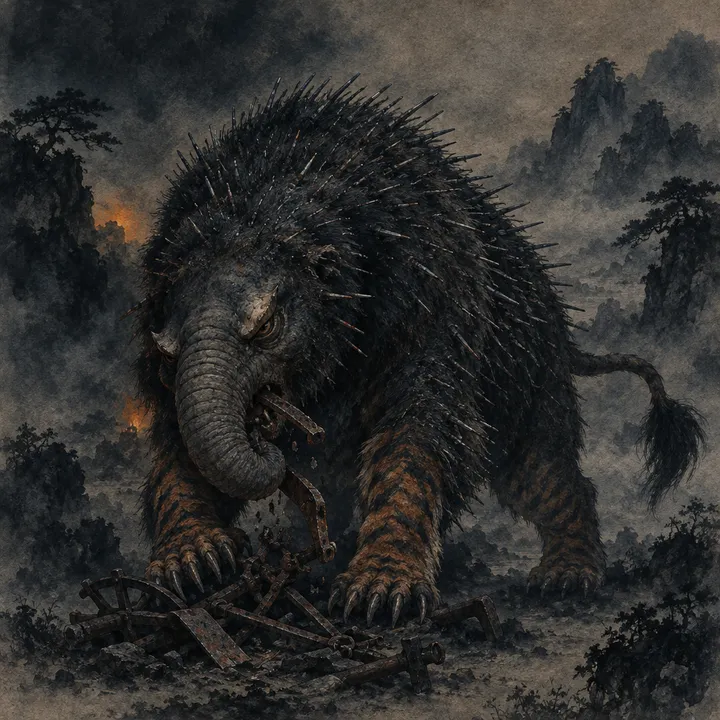
Bulgasari is a Korean legendary beast that eats iron and grows bigger with every bite. Its name is usually read as 'the one that cannot be killed', and it was also believed to chase away nightmares and disease.
What it looks like
Descriptions mix many animals: a bear's body, an elephant's trunk, rhinoceros eyes, an ox's tail and a tiger's legs, with a hide like iron needles. This mix is very close to the Chinese 'mo' (baku).
Where it appears
Villages and towns where iron could be found: pots, spoons, farm tools and weapons.
What it does
The best-known tale says a man (often a monk in hiding) shaped a tiny creature from grains of rice. It ate a needle, then spoons, then pots, and soon it was eating every piece of iron in the land.
Swords and arrows could not hurt it, because it simply ate the metal. That is why it was 'impossible to kill' (bulgasal, 不可殺).
Weakness & protection
A famous word play says it was not bulgasal ('cannot be killed') but hwagasal (火可殺), 'can be killed by fire'. In many versions it is finally destroyed with fire.
As a good-luck image, it was believed to eat bad dreams and drive off evil, so its picture was carved or painted to protect places.
Where it came from
The story is usually set at the end of the Goryeo dynasty, a time of war and chaos, and some read the iron-eating beast as a picture of a hungry, collapsing state.
Bulgasari images are said to decorate the chimneys of Amisan garden at Gyeongbokgung Palace in Seoul. The 1985 North Korean monster film 'Pulgasari' made the name known abroad.
Fact check
- Is it related to the starfish called bulgasari?
- In Korean, the starfish is also called bulgasari, but that is just the same word. The legend is about the iron-eating beast.
- Why does it look like the baku?
- Both seem to come from the same Chinese idea of the 'mo', a beast said to eat iron and copper. In Japan that beast became the dream-eating baku.
More from 🇰🇷 Korea
- Gumiho A fox that has lived a thousand years and grown nine tails. In Korean folklore…
- Dokkaebi Korea's most famous folk spirit. A dokkaebi is less a demon than a tricky, play…
- Cheonyeo Gwisin (Virgin Ghost) The ghost of a young woman who died unmarried, carrying deep resentment (han).…
- Haetae (Haechi) A mythical beast that can tell right from wrong and guards against fire. Its st…