No.001 · 🇰🇷 Korea · Shapeshifters
Gumiho
구미호 · 九尾狐
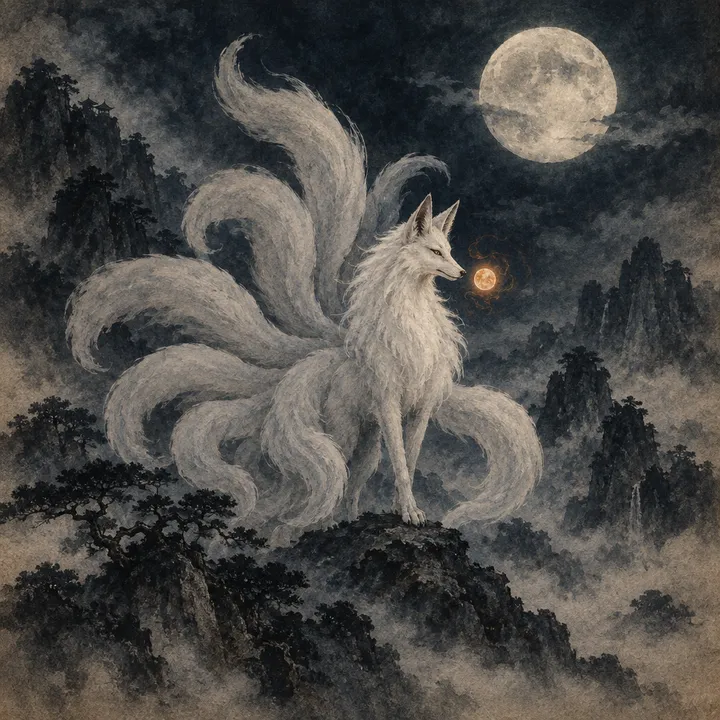
A fox that has lived a thousand years and grown nine tails. In Korean folklore it takes the shape of a beautiful woman and feeds on human livers or hearts, often in the hope of becoming fully human.
What it looks like
A huge fox with nine tails. In human form it is almost always a strikingly beautiful young woman, but something gives it away: a tail that slips out while it sleeps, a fox shadow on the wall, or a habit of sneaking out to graveyards at night.
Where it appears
Deep mountains, old graveyards and lonely mountain passes. In many tales it moves into a village or even a noble household disguised as a bride or daughter.
What it does
The gumiho is a shapeshifter. Most Korean tales say it must eat human livers or hearts, and some versions say that if it eats a hundred (or a thousand) it will become a real human being.
A famous folk tale, often called “The Fox Bead” (여우 구슬), tells of a schoolboy who meets a beautiful girl on his way to the village school. Each time she kisses him she passes a glowing bead into his mouth and takes it back. His teacher realizes he is growing weak and tells him to swallow the bead. He does, the girl turns back into a fox, and the boy gains great knowledge.
Weakness & protection
In the tales, a gumiho is exposed by dogs, which bark at it, and by anyone who follows it at night. Its fox bead is its source of power: lose the bead and it loses its strength.
Some stories say that if a gumiho can keep its true form secret for a hundred days (or avoid killing for a set time), it becomes human, so the people around it are usually the ones who break the spell.
Where it came from
The nine-tailed fox appears in ancient Chinese writing such as the Classic of Mountains and Seas (山海經), where it is described as a beast that eats people. Later Chinese texts also treated it as a lucky sign of a good ruler.
Korea, China and Japan (kyūbi no kitsune) all have nine-tailed fox legends, but the Korean gumiho stands out for being almost always dangerous and for its longing to become human. That longing made it a favorite of modern Korean dramas and films.
Fact check
- Is the gumiho always evil?
- Mostly, in traditional Korean tales. Unlike some Chinese and Japanese fox spirits that can be divine messengers or loyal wives, the Korean gumiho is usually a threat. Modern dramas often make it a tragic or romantic character instead.
- Does the gumiho eat livers or hearts?
- Both appear. Liver is the most common in Korean oral tales, but heart is also told. Which organ depends on the storyteller and region.
More from 🇰🇷 Korea
- Dokkaebi Korea's most famous folk spirit. A dokkaebi is less a demon than a tricky, play…
- Cheonyeo Gwisin (Virgin Ghost) The ghost of a young woman who died unmarried, carrying deep resentment (han).…
- Haetae (Haechi) A mythical beast that can tell right from wrong and guards against fire. Its st…