No.004 · 🇰🇷 Korea · Sacred beasts
Haetae (Haechi)
해태 · 해치 · 獬豸
A mythical beast that can tell right from wrong and guards against fire. Its stone statues sit in front of Gyeongbokgung Palace, and it is the official symbol of Seoul.
What it looks like
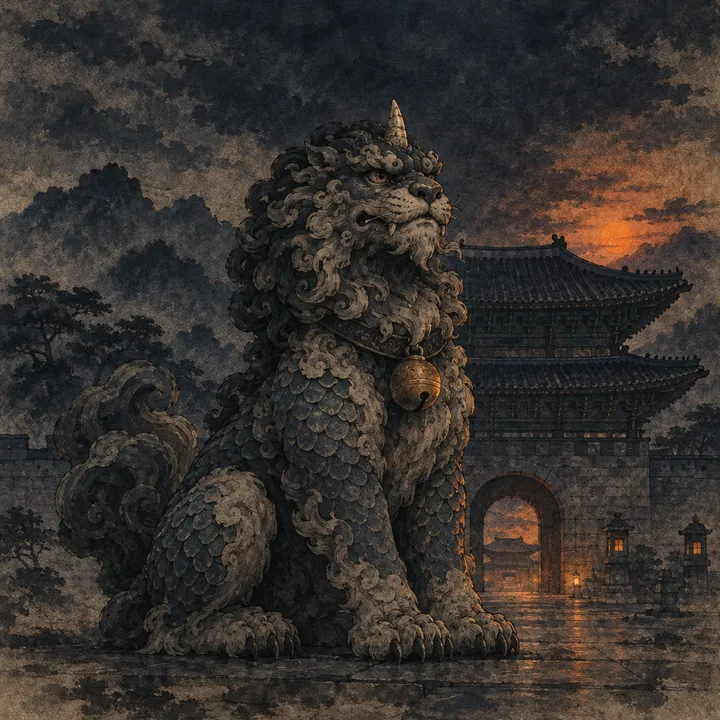
A lion-like body covered in scales, a curly mane, a bell around its neck in many carvings, and in older descriptions a single horn on its head. Korean palace statues usually look friendly and round-faced rather than fierce.
Where it appears
Not a creature of the wild. It stands guard: at palace gates, in front of government offices and on rooftops.
What it does
The haetae is a judge. Old Chinese legend says it would butt or bite the guilty party in a dispute, which is why it became a symbol of justice and law officials.
In Korea it also became a protector against fire. The pair in front of Gwanghwamun Gate of Gyeongbokgung were often explained as guarding the palace from the fire energy of nearby Gwanaksan Mountain.
Weakness & protection
The haetae has no weakness in the usual sense. It only threatens liars and wrongdoers. If you have nothing to hide, it is on your side.
Where it came from
The beast comes from the Chinese xiezhi (獬豸), described in Han-dynasty texts as a one-horned creature that sensed guilt. Officials in charge of law sometimes wore hats decorated with it.
In Korea it took the friendlier name haetae (or haechi). Seoul adopted Haechi as its city symbol in 2008, and you can find its cartoon form on signs, souvenirs and city mascots.
Fact check
- Is the haetae a lion or a dog?
- Neither. It is a mythical beast. Its looks borrowed from lions in art, but it is a separate creature.
- Did the statues really protect against fire?
- That is a popular explanation, not a recorded fact. Gyeongbokgung did burn more than once, including during the Imjin War in 1592.
More from 🇰🇷 Korea
- Gumiho A fox that has lived a thousand years and grown nine tails. In Korean folklore…
- Dokkaebi Korea's most famous folk spirit. A dokkaebi is less a demon than a tricky, play…
- Cheonyeo Gwisin (Virgin Ghost) The ghost of a young woman who died unmarried, carrying deep resentment (han).…