No.006 · 🇯🇵 Japan · Spirits & yokai
Yuki-onna (Snow Woman)
雪女 · ゆきおんな
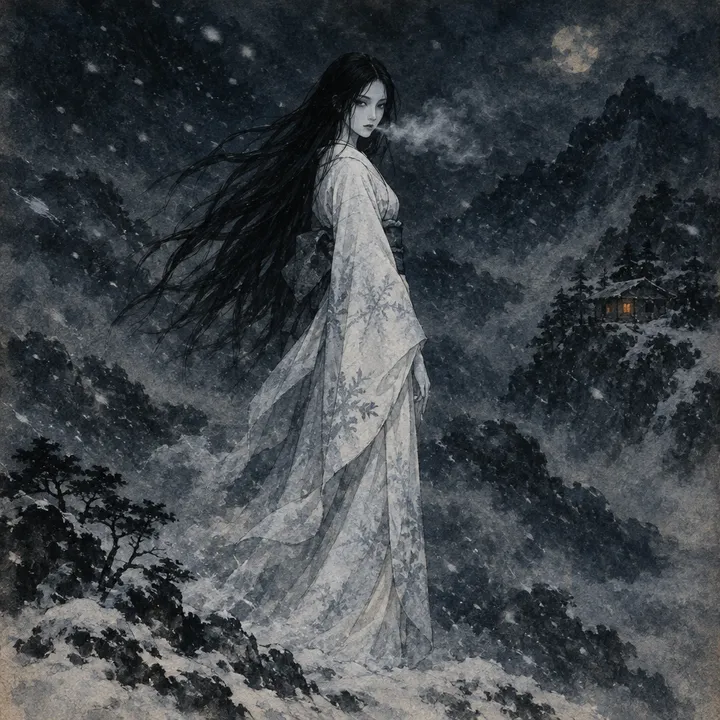
A beautiful, deathly pale woman who appears on snowy nights. Her icy breath freezes travelers to death, yet in the most famous version she spares a young man and later becomes his wife.
What it looks like
Tall, slender and extremely pale, almost transparent against the snow, with long black hair and a white kimono. Some say she leaves no footprints.
Where it appears
Snowy mountains and blizzards, especially in the snow country of northern Japan. She appears to people lost or sheltering from a storm.
What it does
In Lafcadio Hearn's retelling in “Kwaidan” (1904), two woodcutters, old Mosaku and young Minokichi, shelter in a hut during a blizzard. A woman in white breathes on Mosaku and he freezes to death. She spares Minokichi because he is young and handsome, but warns him never to tell anyone.
Years later Minokichi marries a pale, beautiful woman named O-Yuki and they have children. One night he tells her about the snow woman. She reveals she was that woman. She spares him only for the children's sake, and melts away into a white mist.
Other regional tales are darker: she asks people to hold her baby, which grows heavier and heavier until they are buried in snow, or she simply steals the life of anyone who answers her.
Weakness & protection
In most tales, there is no fighting her. You survive by keeping her secret, by being kind, or simply by not being out in the snow at night.
Where it came from
One early written record is Sōgi Shokoku Monogatari (1685), a collection of tales told as the travels of the Muromachi-period poet Sōgi, in which he meets a snow woman in Echigo Province.
Hearn heard the version above from a farmer in Musashi Province (today's Tokyo area). His English retelling made her famous worldwide, and it was adapted into the 1964 film “Kwaidan.”
Fact check
- Is Hearn's version the original?
- No. It is one retelling, and the most famous. Older and regional versions differ a lot, and some are much crueler.
- Is the snow woman a ghost?
- She is usually counted as a yokai, a spirit of snow, rather than the ghost of a dead person, though some tales say she is the spirit of a woman who died in the snow.