No.005 · 🇯🇵 Japan · Spirits & yokai
Kappa
河童 · かっぱ
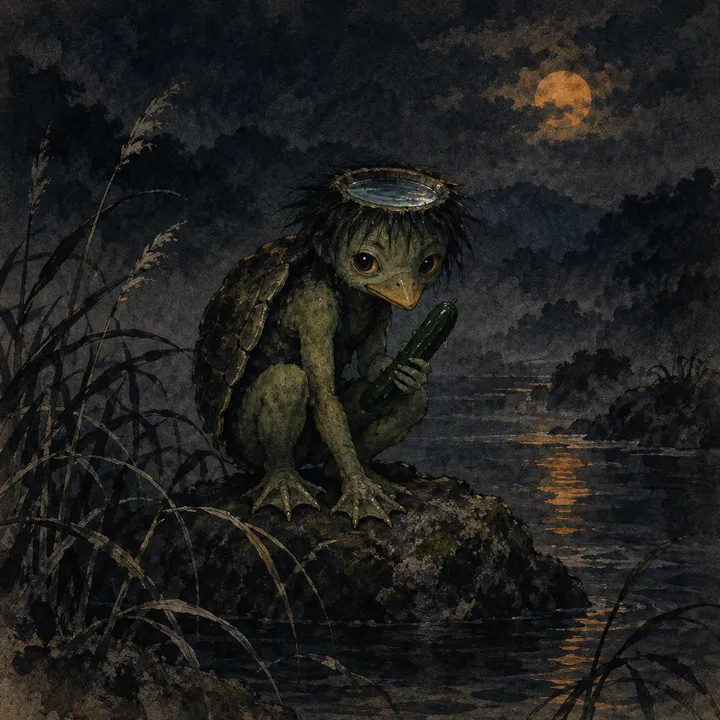
A child-sized river yokai with a beak, a turtle-like shell and a dish of water on top of its head. It drags people and horses into rivers, but it also loves cucumbers, sumo and keeping promises.
What it looks like
Green or yellow-brown skin, webbed hands and feet, a beak-like mouth, a shell on its back, and a shallow dish (sara) on its head that must stay filled with water. It is about the size of a child.
Where it appears
Rivers, ponds, irrigation canals and marshes all over Japan. Signs near water in some towns still warn children about kappa.
What it does
Kappa pull swimmers and horses into the water. Old tales say they steal the shirikodama, an imaginary ball believed to sit inside a person's body, which explained the look of drowned bodies.
They love cucumbers, which is why cucumber sushi rolls are called kappa-maki. They also love sumo and challenge passersby to wrestle.
A kappa that loses or is caught often begs for mercy and promises to help people, teach them how to set bones, or never attack the village again. In the tales, kappa keep their word.
Weakness & protection
Bow to a kappa. It is very polite and will bow back, spilling the water from its head dish. Without that water it loses its strength and may be unable to move.
Some families threw cucumbers with their names written on them into the river so the kappa would leave them alone.
Where it came from
Kappa tales are found across Japan under many local names (kawatarō, gataro, enkō and more). They were likely a way to warn children away from dangerous water.
Yanagita Kunio's “The Legends of Tōno” (Tōno Monogatari, 1910) records kappa stories from Iwate Prefecture, and the Kappabuchi pool in Tōno is still a tourist spot.
Fact check
- Is kappa-maki really named after the yokai?
- Yes. Cucumber rolls are called kappa-maki because kappa are said to love cucumbers.
- Are there “real” kappa mummies?
- Several temples display so-called kappa mummies. Studies of some of them have found they are made from parts of other animals, a common trick in old curiosity displays.
More from 🇯🇵 Japan
- Yuki-onna (Snow Woman) A beautiful, deathly pale woman who appears on snowy nights. Her icy breath fre…
- Tengu Proud, powerful mountain spirits of Japan, shown either as red-faced men with v…