No.007 · 🇯🇵 Japan · Spirits & yokai
Tengu
天狗 · てんぐ
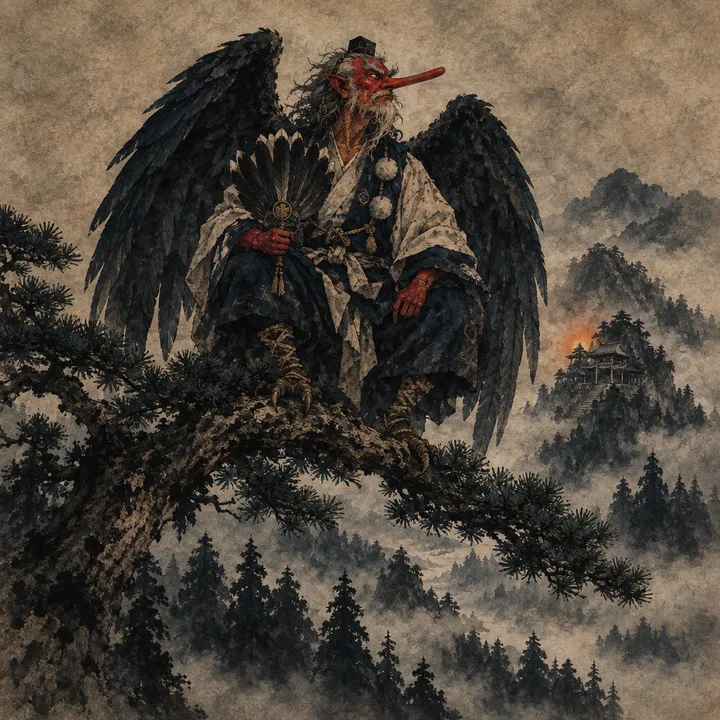
Proud, powerful mountain spirits of Japan, shown either as red-faced men with very long noses or as crow-like bird people. Once feared as demons, they later became protectors and teachers of martial arts.
What it looks like
There are two main types. The daitengu has a red face, a long nose, wings, and the clothes of a yamabushi mountain monk, often holding a feather fan. The karasu tengu (crow tengu) has a bird's beak and black wings.
Where it appears
Deep mountains and forests, especially sacred mountains such as Kurama near Kyoto and Takao near Tokyo, where tengu statues still guard temple paths.
What it does
In older Buddhist tales, tengu are troublemakers who tempt monks, start fires and lead people astray out of pride.
People who disappeared in the mountains were said to have been taken by tengu, an event called tengu-kakushi (spirited away by tengu). Some came back days later, dazed, saying they had flown with the tengu.
The most famous tengu, Sōjōbō of Mount Kurama, is said to have taught swordsmanship to the young warrior Minamoto no Yoshitsune in the 12th century.
Weakness & protection
Tengu hate arrogance in others, though they are arrogant themselves. In Japanese, “to become a tengu” (天狗になる) means to become conceited.
Respecting the mountain and its shrines is the traditional way to stay on a tengu's good side.
Where it came from
The name comes from the Chinese tiangou (天狗, “heavenly dog”), a creature linked to meteors and eclipses. The Nihon Shoki records a loud meteor in 637 that a monk called a tengu.
Over the centuries the Japanese tengu changed from a dog-like omen to a bird-like demon, and finally to the long-nosed mountain guardian known today.
Fact check
- Why do tengu have long noses?
- The long-nosed look became common in the Edo period. Before that, tengu were mostly drawn with bird beaks. One theory links the nose to masks used in festivals.
- Are tengu good or evil?
- Both. Early tales make them dangerous demons, while later beliefs worship them as mountain gods and protectors.
More from 🇯🇵 Japan
- Kappa A child-sized river yokai with a beak, a turtle-like shell and a dish of water…
- Yuki-onna (Snow Woman) A beautiful, deathly pale woman who appears on snowy nights. Her icy breath fre…