No.036 · 🇨🇳 China · Sacred beasts
Fenghuang
鳳凰
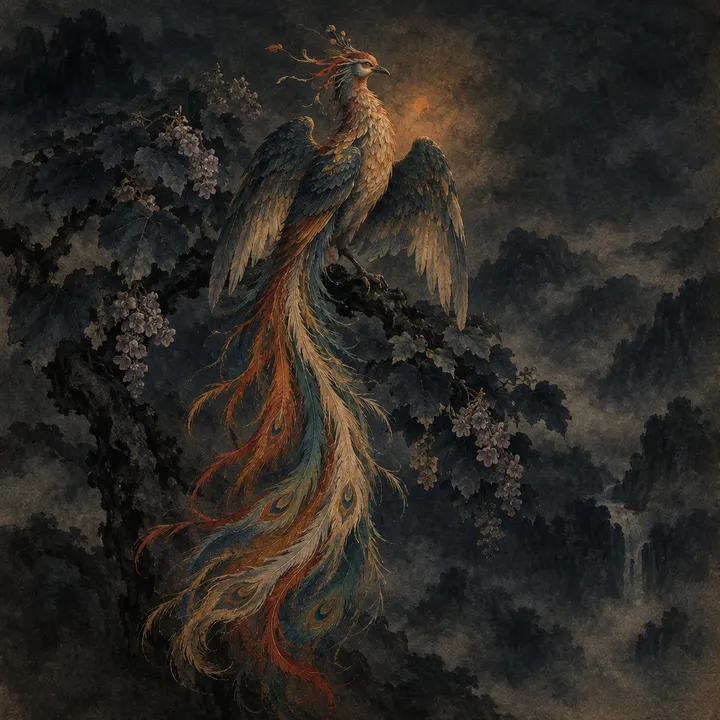
The fenghuang is the sacred bird of Chinese legend, often called the Chinese phoenix. It appears only in times of peace and good rule, and became a symbol of the empress, harmony and good fortune.
What it looks like
A beautiful bird with a long, flowing tail of five colors, often described as mixing parts of many birds, such as a pheasant's head and a swallow's chin.
Where it appears
Holy mountains and the wutong (Chinese parasol) tree, the only tree it will perch on.
What it does
The classic Zhuangzi says it rests only on the wutong tree, eats only bamboo seeds and drinks only from sweet springs, showing its purity.
Originally feng was the male and huang the female. Later the pair became one bird, matched with the dragon as a symbol of the empress beside the emperor.
Weakness & protection
It does not appear in times of war or bad rulers. Its absence itself was read as a sign that the world was not well.
Where it came from
The fenghuang appears in Chinese texts and art for thousands of years, on jade, embroidery, wedding clothes and palaces.
Korea's presidential emblem shows a pair of phoenixes (bonghwang), and the bird is common in Korean and Japanese (hō-ō) art as well.
Fact check
- Is the fenghuang reborn from fire?
- No. That is the Western phoenix. The fenghuang is about peace and virtue, not rebirth from flames.
- Why is it linked to weddings?
- Because the dragon and phoenix together stand for a happy, balanced couple.
More from 🇨🇳 China
- Jiangshi (Hopping Vampire) A stiff, reanimated corpse from Chinese folklore that hops with its arms stretc…
- Qilin A gentle, auspicious beast of Chinese myth that appears only when a wise ruler…
- Nian Nian is the monster of a famous Chinese New Year legend. Once a year it came ou…
- Baize Baize is a sacred white beast of Chinese legend that can speak and knows the na…
- E Gui (Hungry Ghost) E gui, or hungry ghosts, are spirits doomed to endless hunger and thirst. In Ch…