No.008 · 🇨🇳 China · Undead
Jiangshi (Hopping Vampire)
僵尸 · 殭屍
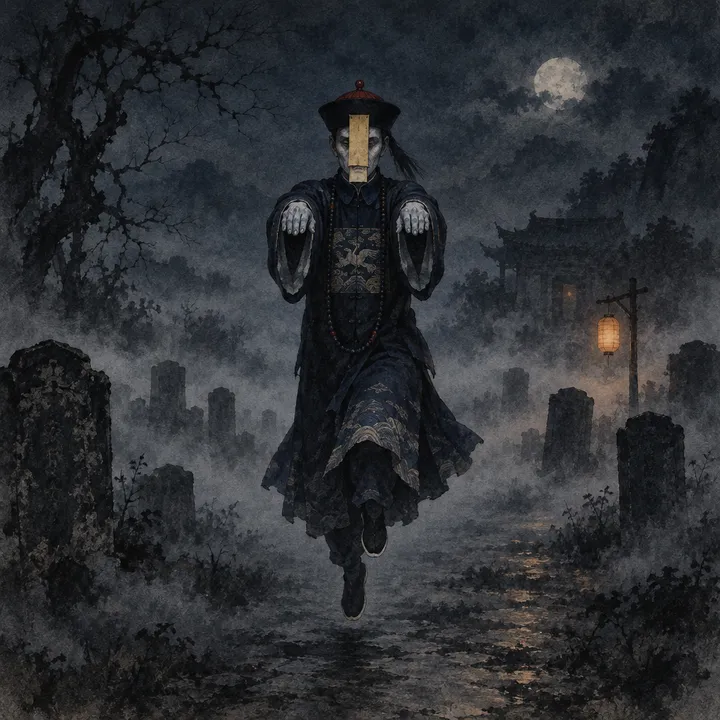
A stiff, reanimated corpse from Chinese folklore that hops with its arms stretched out and drains the life energy (qi) of the living. A yellow paper talisman on its forehead keeps it still.
What it looks like
A corpse with grayish or greenish skin, dressed in the official robes and hat of a Qing-dynasty mandarin. Its body is so stiff that it cannot walk, so it hops with both arms held straight out in front.
Where it appears
Coffins, graveyards and dark roads at night. Some stories place them in old inns where traveling corpses were stored overnight.
What it does
The name means “stiff corpse.” Rigor mortis is the reason it hops and holds its arms out.
A jiangshi hunts the living by sensing their breath, and drains their qi. Some tales say that holding your breath makes you invisible to it.
The image is tied to a real custom from western Hunan, known as “corpse driving in Xiangxi” (湘西赶尸). Families who could not afford a carriage hired Taoist priests to bring the bodies of relatives who died far away back home for burial, walking only at night.
Weakness & protection
A yellow Taoist talisman stuck on its forehead stops it. In films, the talisman falling off is when the trouble begins.
Other common protections include glutinous rice, mirrors, peach-wood swords, the sound of a bell, and the blood of a black dog or a rooster.
Where it came from
Stories of reanimated corpses appear in Qing-dynasty collections such as Ji Yun's “Notes of the Thatched Abode of Close Scrutiny” (閱微草堂筆記) and Yuan Mei's “What Confucius Did Not Speak Of” (子不語).
The hopping jiangshi became a pop-culture icon through 1980s Hong Kong horror comedies, especially “Mr. Vampire” (1985), and spread across East Asia from there.
Fact check
- Did corpse driving really happen?
- Corpse-transport customs in Xiangxi are widely reported in Chinese sources. How exactly the bodies were moved (on poles, carried on backs, or in other ways) is debated, but they did not actually hop on their own.
- Why is it called a “Chinese vampire”?
- Because it drains life from the living. But it feeds on qi, not blood, in most traditional stories.
More from 🇨🇳 China
- Qilin A gentle, auspicious beast of Chinese myth that appears only when a wise ruler…