No.009 · 🇨🇳 China · Sacred beasts
Qilin
麒麟 · qílín
A gentle, auspicious beast of Chinese myth that appears only when a wise ruler or sage is born or dies. It is so kind it will not step on living grass.
What it looks like
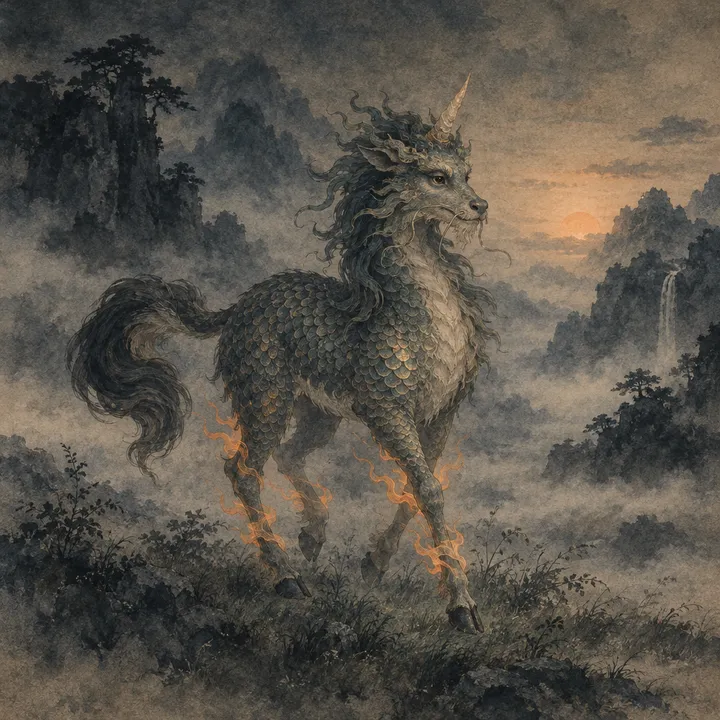
Descriptions vary, but a classic one gives it the body of a deer, the tail of an ox, the hooves of a horse, scales on its body and one fleshy horn. Later art often adds a dragon-like head and flames around its legs.
Where it appears
It does not live among people. It appears briefly, as a sign from heaven, in times of peace and good government.
What it does
The qilin is one of the four benevolent animals in Chinese tradition, along with the dragon, the phoenix and the tortoise.
Legend says a qilin appeared to Confucius's mother before he was born, spitting out a jade tablet that foretold his greatness.
The “Spring and Autumn Annals,” the chronicle associated with Confucius, ends with the capture of a lin in 481 BC. Tradition says Confucius wept, seeing it as a sign that his own time was ending.
Weakness & protection
The qilin is not dangerous to good people. It is said to punish the wicked, but harming one was itself a terrible omen.
Where it came from
The qilin appears in some of the oldest Chinese texts, including the Book of Songs (詩經).
When Admiral Zheng He's fleet brought a giraffe to the Ming court in 1414, it was presented as a qilin. That is why the word for giraffe is kirin (キリン) in Japanese and girin (기린) in Korean to this day.
Fact check
- Is the qilin the same as a Western unicorn?
- They are often compared, but they come from different traditions. The qilin is not a horse, and many depictions give it two horns or none.
- Is the Kirin beer logo a qilin?
- Yes. The Japanese beer brand uses the mythical kirin, not a giraffe, as its symbol.
More from 🇨🇳 China
- Jiangshi (Hopping Vampire) A stiff, reanimated corpse from Chinese folklore that hops with its arms stretc…