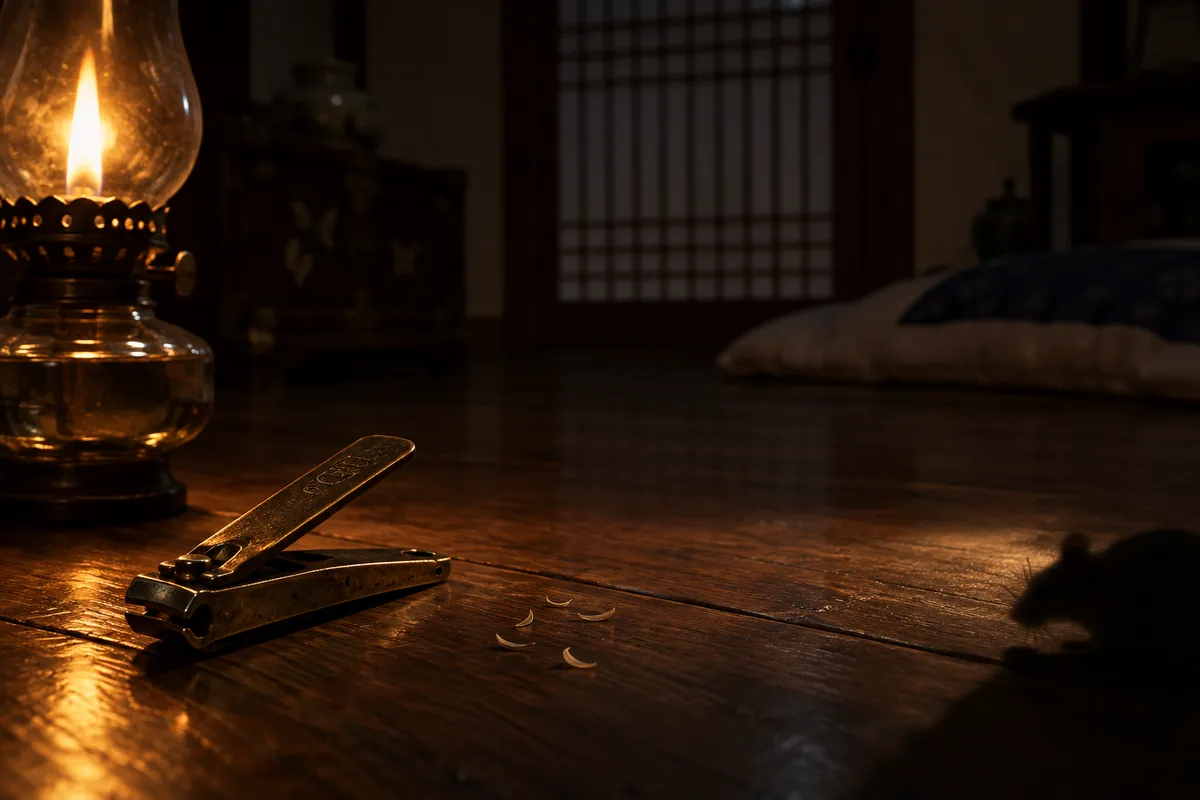
Don't Cut Your Nails at Night: Korea's Rat Legend Explained
Why shouldn't you cut your nails at night? Ask almost any Korean grandmother and you'll hear the same warning: "If you clip your nails after dark, a rat will eat the clippings and turn into you." Japan has a similar rule with a different threat: cut your nails at night and you won't be at your parents' side when they die. Here's the folk tale behind the Korean version, the most common explanations for the "night" part, and what actually matters when you trim your nails. ▶ The rat that ate the nails The story most often told with this taboo is a Korean folk tale sometimes called "The Real Master and the Fake Master." The Encyclopedia of Korean Culture lists it among Korean shapeshifting tales. It goes roughly like this. A man carelessly tossed his nail clippings wherever he happened to be. A rat found them and ate them, again and again, for a long time. One day the rat turned into a perfect copy of the man and moved into his house. His family couldn't tell which one was real. Even the local magistrate got it wrong and threw the real man out. The real master wandered until someone helped him and he came home with a cat. The cat leapt on the fake master and killed him, and as he died he turned back into a rat. The encyclopedia links the tale to an old idea: your hair and nails were given to you by your parents, so you shouldn't treat them carelessly. Throw away pieces of yourself, and you might end up losing yourself. Interestingly, the encyclopedia entry does not say anything about night. When the night rule and the rat story were first tied together is not clear. ▶ Why "at night"? Three theories 1. The darkness theory. Before electricity, people trimmed their nails by oil lamp or moonlight. In the dark it was easy to cut into the skin, and small cuts could get infected. The Japanese lifestyle site All About gives the same explanation for Japan's version of the rule. 2. The scattered clippings theory. In a dark room you can't find all the little pieces. Left on the floor, they could be stepped on or picked up by a baby. The rat story may simply be a scary way to say "clean up after yourself." 3. The wordplay theory. In Japanese, "night nails" (yozume) sounds like a phrase meaning "to shorten one's life." This explains the Japanese taboo, but it doesn't work in Korean, so it probably isn't where the Korean rule came from. ▶ Why nails and hair felt dangerous Nails and hair don't rot quickly once they leave the body. In many cultures, that made people feel that something of the person stayed in them, and that someone could use your hair or nails against you. In Korea the idea also met Confucian filial piety. A famous line from the Classic of Filial Piety says that your body, hair and skin come from your parents, and not harming them is the beginning of respect. Put that together with a rat that steals your identity, and you get a very memorable rule. There's another nice detail: in the tale, the hero is a cat. In the days when rats stole grain and spread disease, cats were the animals that protected the house. The roles in the story match real life. ▶ So is it actually bad to cut your nails at night? There's no scientific evidence that the time of day matters. What matters is the setting: - Trim in good light. Cutting into the skin beside the nail can lead to swelling and infection around the nail. - Don't cut too short. Leave the nail edge slightly past the skin. - Pick up the clippings right away, especially with babies or pets in the house. - Wash your hands and clippers afterwards. If the skin around a nail becomes swollen or fills with pus, see a doctor. This article is general information, not medical advice. ▶ Quick questions Do rats really eat nails? Rats are omnivores and will gnaw on many things, but turning into a person is folk tale, not biology. How should I throw away clippings? Gather them in a tissue and put them in the trash. Old stories say people burned or buried them so rats couldn't get them, but that isn't necessary today. Is this a kind of doppelganger story? Yes, very much. A double who takes your place is the core of it, and some people call it Korea's doppelganger tale. ▶ What did your family say? A single clipping carried a whole lesson: don't throw pieces of yourself away. Did you grow up with a nail superstition, or a different night-time rule? Tell us in the comments. More Korean legends: https://unnlog.com/talk/182 Korean ghosts and monsters, 18 types: https://unnlog.com/talk/181 Sources: Encyclopedia of Korean Culture (shapeshifting rat tale), All About Japan (night nail-cutting taboo), Classic of Filial Piety. General information only, not medical advice.