No.016 · 🇷🇴 Romania · Undead
Strigoi
Strigoi
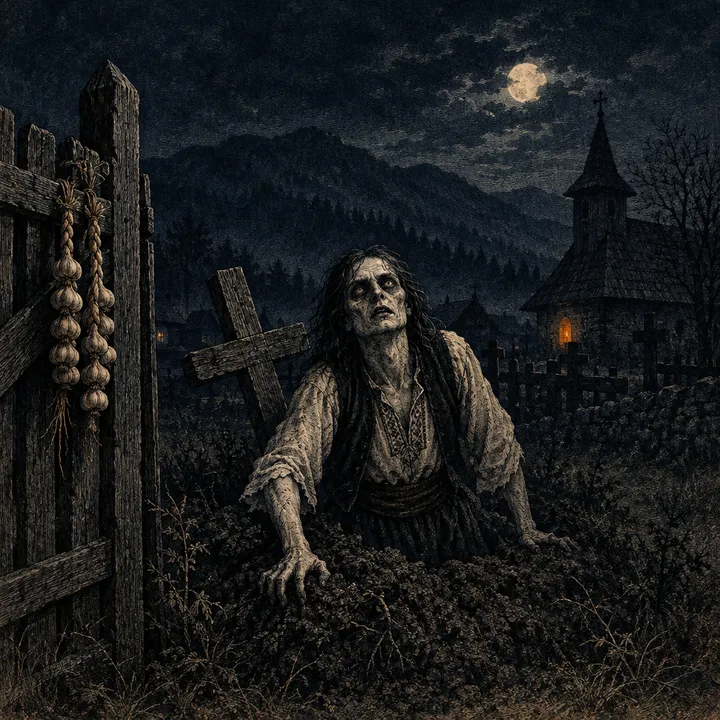
Strigoi are the troubled dead of Romanian folklore: souls that rise from the grave at night to bother their families and drain the life of the living. They are one of the old roots of the European vampire.
What it looks like
A strigoi mort (dead strigoi) often looks like the person did in life, but pale or red-faced, sometimes with a body that has not decayed in the grave.
Where it appears
Villages, homes of relatives, crossroads and graveyards, especially on certain nights such as St. Andrew's Eve and St. George's Eve.
What it does
Folklore separates the strigoi mort, a dead person who returns, and the strigoi viu, a living person (often a witch) whose soul leaves the body at night to meet other strigoi.
People believed some were born at risk: a baby born with a caul, with a tail-like mark, or the seventh child of the same sex.
Weakness & protection
Garlic on doors, windows and even rubbed on cattle, especially on St. Andrew's Eve.
In old village practice, a suspected grave was opened and the body was staked, turned face down or the heart burned. These rites were reported into the 21st century in rare cases.
Where it came from
Strigoi beliefs come from old Balkan and Slavic traditions about the restless dead. The name is linked to the Latin strix, a screeching night bird.
19th-century writings about Transylvanian beliefs are said to have helped Bram Stoker when he wrote 'Dracula', though Dracula himself is a literary creation.
Fact check
- Is a strigoi a vampire?
- It is one of the folk ancestors of the vampire, but folk strigoi are less about fangs and more about sickness, bad luck and the dead not resting.
- Was Vlad the Impaler a strigoi?
- No. The real Vlad III was a 15th-century prince. Linking him to vampires came later, mainly through Stoker's novel.